 9. Retinal Oximetry and Retinal Vein Occlusion
Einar Stefánsson, S. H. Hardarson, R. Karlsson, G. H. Halldorsson, T. Eysteinsson,
J. A. Benediktsson, J. M. Beach (Reykjavík)
Purpose: A non-invasive study of the oxygen saturation of retinal venules in eyes with retinal
vein occlusion (RVO) and how laser treatment affects the oxygen saturation.
Methods: Our automatic non-invasive retinal oximeter yields fundus images with 4 wavelengths
of light simultaneously and calculates optical density ratio, which is linearly related to
hemoglobin oxygen saturation (SO2). We performed oximetry in 7 patients with RVO. We measured
the healthy fellow eye, and retinal venules outside and inside the occluded area in the
RVO eye before and after laser treatment. Differences were analyzed with two-way ANOVA and
Bonferroni post tests and with a paired t-test.
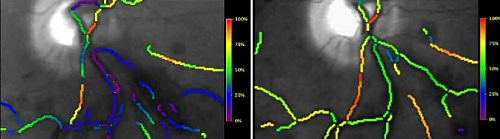
Results: The venular SO2 was 59±6 % in healthy fellow eyes (mean±SD; n=5), 60±12 % in
non-occluded areas of RVO eyes (n=4), 39±23 % before laser in occluded venules (n=5) and 56±4 % in occluded venules following laser treatment (n=5). Before laser the occluded venules have a significantly lower SO2 than healthy eyes or nonoccluded
areas of RVO eyes (p<0.05) and the SO2 was normalized by laser treatment. In the 4 eyes measured both before
and after laser treatment the SO2 rose from 38±26 % to 57±4 % (p= 0.24, paired t-test). The figure shows a pseudocolor SO2 map before and after laser treatment.
Conclusions: The automatic non-invasive retinal oximeter demonstrates decreased oxygen saturation in occluded retinal venules compared with healthy areas of the RVO eyes and healthy eyes. Laser treatment in RVO brings the oxygen saturation
back to normal values.