MAKULA
 VISCOELASTIC FOVEAL DETACHMENT AND ENDOSCOPIC SUBRETINAL LASER ABLATION OF SUBFOVEAL CHOROIDAL
NEOVASCULARIZATION
VISCOELASTIC FOVEAL DETACHMENT AND ENDOSCOPIC SUBRETINAL LASER ABLATION OF SUBFOVEAL CHOROIDAL
NEOVASCULARIZATION
Hugo Quiroz-Mercado, I. Yeshurun, J. L. Guerrero Naranjo, M. Turati,
J. G. García-Aguirre, L. Morfin, F. Koch (Mexico)
Purpose: To demonstrate the ability to use endoscopic laser ablation
of subfoveal choroidal neovascularization (CNV) with 532 nm laser following
viscoelastics foveal detachment.
Methods: Eight eyes of eight patients with subfoveal CNV underwent
surgery with subretinal laser ablation. The surgical procedure performed
was as follows: pars plana three-port vitrectomy, posterior hyaloid removal,
subretinal injection of sodium hyaluronate (SH) through a small retinotomy
to separate the retina from the CNV-RPE complex, creation of a dome shaped
retinal detachment with the SH bubble, endoscopic laser ablation, SH aspiration,
air-fluid exchange, SF6 as tamponade, and face down positioning. Preoperative
and postoperative visual acuity (ETDRS chart) and fluorescein angiography
(FA) were evaluated, as well as the presence of complications.
Results:
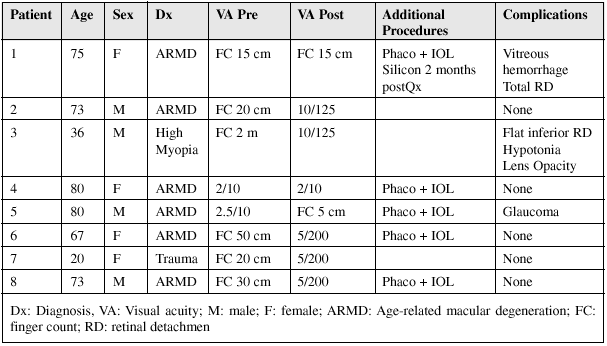
Five eyes had improved visual acuity by three lines or better, two eyes
remained unchanged and one eye had severe diminishment of visual acuity.
Complications included one vitreous hemorrhage with total retinal detachment,
one partial retinal detachment and one patient with secondary glaucoma.
In all cases preoperative FA showed late hyperfluorescence consistent
with CNV. In seven of eight cases postoperative FA showed hyperfluorescent
areas, which could be suggestive of proliferating RPE.
Conclusions: Viscoelastic foveal detachment and endoscopic subretinal
laser ablation of subfoveal choroidal neovascularization is a feasible
and novel surgical procedure which warrants further study and evaluation.
Back